
In What Ways Might Focused Attention Meditation Improve Everyday Life?

Updated: Aug 13, 2025
In today's world, we are overwhelmed with information, leading to constant distractions. When was the last time that, while working on your computer, a notification popped up on your phone, pulling your focus away from your work? Then, almost immediately you received a notification on your computer that your next meeting is in 15 minutes. As a result, you lost track of what you were doing just a moment ago. Similarly, when was the last time that, while reading a book, you started thinking about what to cook for dinner, or you found yourself daydreaming about your next vacation instead of listening to a friend during a meeting? These distractions, whether externally triggered or internally generated, make it easy to lose focus.
Solution
Focused attention meditation can be a valuable tool to help us learn or remind us how to engage and sustain our attention. It might be an effective way to manage these distractions and maintain concentration.
What is focused attention meditation?
Specifically, focused attention meditation involves engaging and sustaining one’s attention explicitly on a target stimulus in the present moment while actively disengaging from unrelated exogenous (e.g., other body sensations and visual/auditory stimuli) and endogenous (e.g., mind-wandering, spontaneous thoughts) distractors (Ganesan et al., 2022).
Typically, the attentional targets of focused attention meditation include the individual’s own interoceptive sensations, such as breathing, or an external sensory stimulus, while distractors refer to stimuli other than the target (Brewer et al., 2011; Fox et al., 2016; Lutz et al., 2008b). Therefore, the emphasis of focused attention meditation is on engagement and re-engagement of attention with the target stimulus (e.g., breath) and disengagement from non-target stimuli (or distractors).
From the Neuroscientific Perspective
Brain Patterns
Using advanced neuroimaging techniques, it was found that certain brain regions are implicated in focused attention meditation. These include the anterior cingulate cortex (ACC), posterior cingulate cortex (PCC), medial prefrontal cortex (mPFC), dorsolateral prefrontal cortex (DLPFC), and insula, which are among the most consistently implicated brain regions in focused attention meditation. Some regions were commonly activated (ACC and DLPFC), while others were commonly deactivated (mPFC and PCC). The implicated regions comprise three key functional networks: the Default Mode Network (DMN), the Salience Network, and the Control Network.
The magnitude of activation and functional connectivity associated with regions can be influenced by factors such as meditation expertise.
Importantly, the overall neurocognitive mechanism of focused attention meditation may be common to both expert and novice meditators. However, meditation expertise, self-reported mindfulness levels, and sustained attention levels can significantly influence the magnitude of activation and functional connectivity associated with the regions constituting these networks.
Brain Functional Differences Between Novice and Expert Meditators
In more detail, as mentioned, there were no regions or networks consistently recruited more often by one group compared to the other. However, the magnitude of activation and functional coupling within these networks differed considerably between them. For example:
In the Control Network, i.e., DLPFC, there was significantly greater activation in experts.
Based on whole-brain analysis, expert meditators, as opposed to novices, showed greater sparseness in whole-brain connectivity with lower overall activation intensity, suggesting greater efficiency of brain activity in experts (Hiroyasu and Hiwa, 2017).
Similarly, the spatiotemporal complexity of brain activity across the whole brain was less dynamic in experts, leading to reduced switching between different whole-brain functional connectivity states in expert versus novice meditators (Escrichs et al., 2019).
These are just a few selected findings from the original research. If you would like to learn more, please go back to the original research.
What Did We Learn?
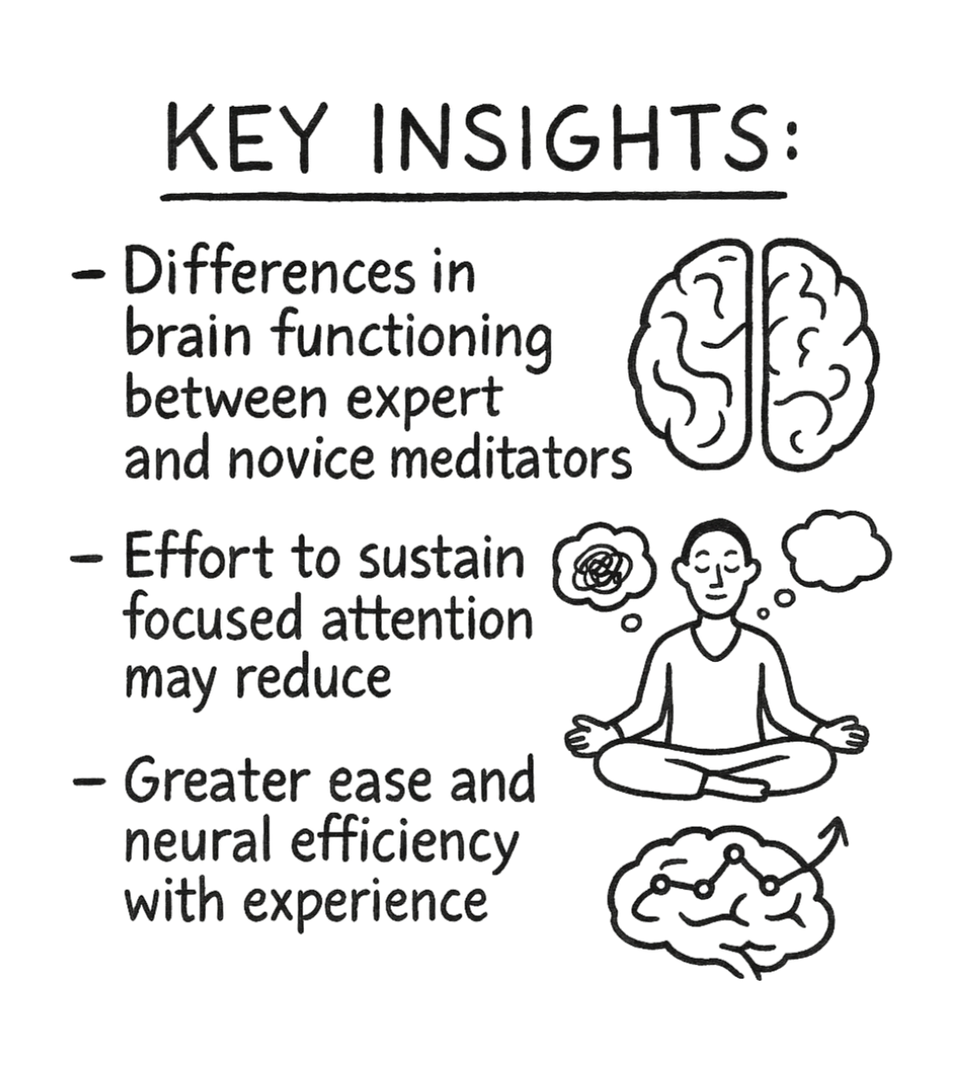
There are some differences in brain functioning between expert and novice meditators.
As one continues practicing focused attention meditation, the effort needed to sustain focused attention and managing dominant distractions may reduce.
With greater experience, individuals likely develop enhanced ease and neural efficiency in activating and sustaining desired cognitive states, as demonstrated by experts transitioning more efficiently between whole-brain functional connectivity states compared to novices.
References
Brewer JA, Worhunsky PD, Gray JR, Tang YY, Weber J, Kober H. Meditation experience is associated with differences in default mode network activity and connectivity. Proc Natl Acad Sci U S A. 2011;108(50):20254–20259. https://doi.org/10.1073/pnas.1112029108
Escrichs A, Sanjuán A, Atasoy S, López-González A, Garrido C, Càmara E, Deco G. Characterizing the dynamical complexity underlying meditation. Front Syst Neurosci. 2019;13:27. https://doi.org/10.3389/fnsys.2019.00027
Fox KC, Dixon ML, Nijeboer S, Girn M, Floman JL, Lifshitz M, Christoff K. Functional neuroanatomy of meditation: A review and meta-analysis of 78 functional neuroimaging investigations. Neurosci Biobehav Rev. 2016;65:208–228. https://doi.org/10.1016/j.neubiorev.2016.03.021
Ganesan S, Beyer E, Moffat B, Van Dam N, Lorenzetti V, Zalesky A. Focused attention meditation in healthy adults: A systematic review and meta-analysis of cross-sectional functional MRI studies. Neurosci Biobehav Rev. 2022;141:104846. https://doi.org/10.1016/j.neubiorev.2022.104846
Hiroyasu T, Hiwa S. Brain functional state analysis of mindfulness using graph theory and functional connectivity. AAAI Spring Symposium Technical Report. 2017.
Lutz A, Slagter HA, Dunne JD, Davidson RJ. Attention regulation and monitoring in meditation. Trends Cogn Sci. 2008;12(4):163–169. https://doi.org/10.1016/j.tics.2008.01.005
Disclaimer: This post is primarily based on the original research by Ganesan et al. (2022), and credit should be given to the original authors.